




The effect of air velocity on filters
In the vast majority of cases, the lower the air velocity, the better the filter will work.
The diffusion (Brownian motion) of small particle size dust is obvious, when the air velocity is low, the airflow stays longer in the filter material, and the dust has more chances to hit the obstacles, so the filtration efficiency will be high.
Similar to the effect of diffusion, when the filter material is electrostatically charged (electret material), the longer the dust is retained in the filter material, the greater the likelihood that it will be adsorbed by the material. Changing the air velocity, the filtration efficiency of the electrostatically charged material will change significantly.If you know that there is static electricity on the material, the air conditioning system design should be carried out in such a way as to minimise the amount of air passing through each filter.
For large particles of dust dominated by inertial mechanism, according to the traditional theory, the chance of collision between dust and fibre will be reduced after the air velocity is reduced, and the filtration efficiency will be reduced accordingly. However, in practice this effect is not obvious, because the air velocity is small, the fibre bounce force on the dust is also small, the dust is more likely to be stuck.
High air velocities result in high resistance. If the service life of the filter is based on the final resistance, a high air velocity will result in a short service life of the filter. It is difficult for general users to actually observe the effect of air velocity on filtration efficiency, but it is much easier to observe the effect of air velocity on resistance.
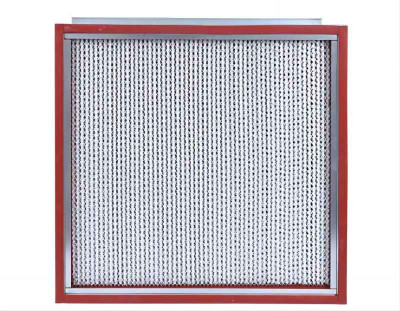
For HEPA filters, the speed of airflow through the filter material is generally 0.01~0.04m/s, in this range, the resistance of the filter is directly proportional to the filter air volume. For example, a 484mm*484mm*220mm HEPA filter has an initial resistance of 250Pa at a rated air volume of 1000m3/h. If the actual air volume in use is 500m3/h, its initial resistance can be reduced to 125Pa. For general ventilation filters in air-conditioning boxes, the velocity of the airflow through the filter material is in the range of 0.13~1.0m/s, and the resistance is no longer linearly related to the air volume, but an upward curve, and the resistance may increase by 50% with an increase of 30% in the air volume. If the filter resistance is a very important parameter for you, you need to ask the filter supplier for the resistance curve.